Magical Worldview
Life in Hunter-Gatherer Societies
From Roadmap to Reality: Consciousness, Worldviews, and the Blossoming of Human Spirit
 |
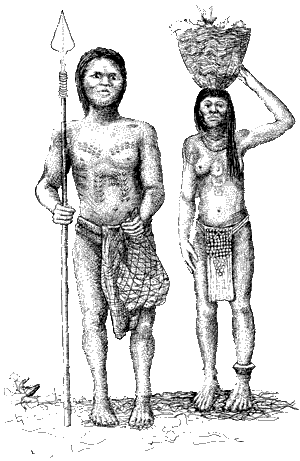
"Most Jivaros are not introspective or moody. They spend little time regretting the past or worrying about the future. Thye live in the present and find it good, most of the time, even though it is filled with dangers. The worst dangers are, in their minds, largely unseen. They fear the inguanchi, the demons or evil spirits, but not the jaguar, the white man or the Jivaro enemy. The Jivaro world abounds with spirits, some good, but most bad. As many things as there are in the world--trees, animals, plants, birds, rivers, fish, butterflies, ants, clouds,
earth, and the shining things in the sky--that is how many spirits there are, and more."
--Lewis Cotlow, In Search of the Primitive |
The Rise of First-Person Perspective
We become whatever we copy, but for tens of thousands of years, there was little human culture to copy. However, advances in technology led to changes in neurological wiring, which were copied from generation to generation. Our human ancestors lived a largely preconscious existence until descriptive metaphors and creative imagination arose with the explosion of stone age technology and culture between 40,000 and 50,000 years ago. For the first time in history, humans looked at their reflection and said, "I am, I want, I need." It was a very first-person oriented perspective.
It was also a very magical perspective, because people did not understand linear cause and effect as we know it. For example, when British explorer John Ross made first contact with the Inuit on the northwest coast of Greenland in the 1800s, the Inuit hesitantly advanced toward his wooden ships with trembling limbs and a look of terror. They asked about the ships through an interpreter. They saw the sails billowing in the wind and believed the ships to be alive. What kind of creatures were they? Were they from the sun or from the moon? After finally coming onboard, the Inuit again asked whether their visitors were from the sun or the moon. Although the Inuit were as human as we are, they were unable to comprehend the nature of their visitors.
Living with a magical perception of reality wasn't a bad thing, just a vastly different experience from our own. Mark J. Plotkin, Ph.D., traveled to the Amazon rainforest in the 1970s and 1980s to learn about medicinal plants from indigenous tribes. While most of his experiences involved identifying and recording the uses of wild plants, there were other unexplainable events, as described in his 1993 book, Tales of a Shaman's Apprentice. In one terrifying dream, "An enormous jaguar strode into my hut and stared deeply into my eyes, as if trying to divine my thoughts." Plotkin believed the dream was some kind of visit from his teacher the Jaguar Shaman, which the shaman confirmed the following day.
Plotkin wrote, "It became totally clear to me that different people, cultures, and places can have their own realities; that just as one can learn the spoken language of a foreign land, one can absorb its spirit--even if that spirit and its wisdom differ radically from those of one's own culture. In a society where people believe hallucinogenic experiences are caused by deities that inhabit sacred plants and that the reality we live every day is merely a dream, why shouldn't a medicine man who consults with the spirit world be able to turn himself into a mighty jungle beast? When I dreamed of the jaguar, I felt the Indians were communicating in a whole new language of exchange--beyond the plants that I had learned or the words that Koita had taught me, a language of other realities."
Notes
1. Lewis Cotlow. In Search of the Primitive. Little, Brown & Co.: Boston. 1942, 1966. Page 197.
2. Ann Savours. The Search for the North West Passage. St. Martin's Press: New York. 1999. Pages 51 - 52.
3. Mark J. Plotkin, Ph.D. Tales of a Shaman's Apprentice. Penguin Books. 1993. Pages 1, 101, 102.
|
|
Next Page: Mythical Worldview
Interesting? Get the whole story!
Order Roadmap to Reality Now
Hi,
Well, your new book is quite good. I first noticed the similiarity to Ken Wilber's organization. His work was a great catalyst and influence on my early questioning around the perfection viewpoint of hunter gatherers. Your material I find is more grounded in content, whereas Wilber's experience seemed to be rooted in transcendance with little life experience or other lifestyles to adequately compare outside of books. At least that's what I read into in how he wrote and the little about his life he shares. The time you spent writing about 'magical' or hunter gatherers/horticultural and the open mindedness I appreciate quite a bit, while seeming to aim at being realistic. I noticed at points about those class of people that when it seemed you might be solidifying into a stiff judgemental stance, that you would offer a counter viewpoint or admit that we may be crossing over our perceptions of another reality.
Ever since reading Wilber I had been wanting to write or read a book that gave the magical cultures more focus, respect, and understanding. I am glad I didn't attempt to write the book!
--Tim Nelson
|