"In the early 1950s, the Dayak people in Borneo had malaria. The World Health Organization had a solution: spray DDT. They did; mosquitoes died; malaria declined; so far, so good. But there were side effects. House roofs started falling down on people's heads, because the DDT also killed tiny parasitic wasps that had previously controlled thatch-eating caterpillars. The colonial government gave people sheet-metal roofs, but the noise of the tropical rain on the tin roofs kept people awake. Meanwhile, the DDT-poisoned bugs were eaten by geckos, which were eaten by cats. The DDT built up in the food chain and killed the cats. Without the cats, the rats flourished and multiplied. Soon the World Health Organization was threatened with potential outbreaks of typhus and plague, and had to call in RAF Singapore to conduct Operation Cat Drop-parachuting a great many live cats into Borneo."
--Amory Lovins, Rocky Mountain Institute
The Rise of Systems Thinking
Although sequential thinking--and the industrial culture that arose with it--is great for building houses, roads, washing machines, and shopping malls, it is inadequate to cope with complex, nonlinear problems, such as social or environmental management issues, or designing high-efficiency houses, cars, and appliances.
Systems thinking arose from the field of systems dynamics, founded in 1956 at the Massachusetts Institute of Technology (MIT) to provide a better means of understanding the interactions of complex systems based on feedback loops. It is an integrated approach that results in a dramatically different interpretation of reality from sequential processing.
For example, businesses are often faced with seemingly insurmountable problems when they decide to pursue sustainable paths. A common approach is to sequentially design products or build a factory first and then wonder what could be done to make the products and processing more environmentally friendly, leaving sustainability as an afterthought. This approach is akin baking a cake without leavening, then trying to add baking powder after the fact--it is problematic and costly!
In terms of house-building, an architect designs a house and passes it along to a heating contractor to calculate the size of the required heating and cooling system. In systems thinking, however, all aspects of house design are considered together, such that money invested in efficient design might allow a less costly heating system or none at all.
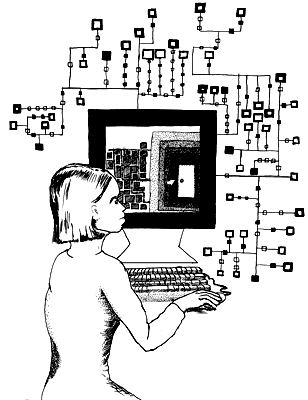
The rise of the Internet introduced systems processing to the broader public. Instead of connecting the dots in a line with sequential processing, the Internet immerses people in a world of web-like interconnections leading in many possible directions. The Internet functions as a positive feedback loop to build a society based on systems thinking. People mimic and learn systems processing through exposure to the Internet. They use that influence to develop newer, more integrated products, services, and software.
Systems-level creativity is exploding across our culture in response to rising fuel costs and concern over global warming. It is astonishing to witness the rapid pace of innovation as entrepreneurs design more efficient cars, lightbulbs, and appliances, and develop new and less costly ways to harness electricity from sunshine, wind, and ocean waves. These and more emerging technologies will enable our species to rapidly reduce and potentially eliminate our carbon emissions to abate global warming. With systems processing we can easily create a sustainable civilization. Unfortunately, this path to sustainability may be shockingly inefficient.
The ideal way to build a sustainable civilization is to make everything inherently efficient, such that buildings conserve water and electricity and require no heating or cooling. With intelligent architecture, it is easy to add a few solar panels to achieve self-sufficiency. However, the greater likelihood is that we will massproduce our way to sustainability by bulldozing rural landscapes for solar and wind developments and blanketing every roof with masses of solar panels.
The irony is that there is a difference between creating a sustainable civilization versus achieving a sustainable environment. Systems processing could enable us to create a sustainable civilization on the moon in the total absence of life. That is the risk of systems processing, that we might create a sustainable civilization while destroying half of all life on earth.
Notes
1. Amory Lovins. "Imagine a World..." Rocky Mountain Institute 25th Celebration Speech. August 2007.